
Mia Hayes · 1 November 2026
Archival Review of Steinlyn's Drafts Exposes Patterns in Essay Refinements
Researchers examining Steinlyn's working papers have identified recurring revision patterns that appear across his major essays, and these patterns emerge from careful comparison of multiple draft stages preserved in private collections. The documents reveal that Steinlyn frequently began with dense introductory paragraphs before systematically expanding supporting sections through repeated insertions of transitional phrases, while cross-references to earlier notes indicate he often restructured entire arguments after initial composition.
Evidence from the papers shows specific techniques such as the addition of qualifying clauses in later drafts, and these changes typically occurred during the second or third revision cycles according to dated annotations. Observers note that Steinlyn tended to shorten sentences in concluding sections while lengthening those in analytical passages, a method that creates rhythmic contrast throughout the final versions of his works.
Key Revision Techniques Documented in the Papers
One consistent approach involves the insertion of comparative examples drawn from contemporary sources, and these additions often appear in the margins before integration into the main text during subsequent passes. Data from the archive indicates that Steinlyn revised at least four key essays using this method between 2018 and 2023, with each instance showing similar layering of handwritten corrections over typed base text.
Further examination reveals that Steinlyn employed a process of deletion and substitution for thematic emphasis, while he replaced abstract terms with concrete references in roughly 60 percent of the examined passages. This substitution pattern aligns with broader trends in postwar German-language scholarship, and it connects to practices documented in related archival holdings at institutions across Europe.
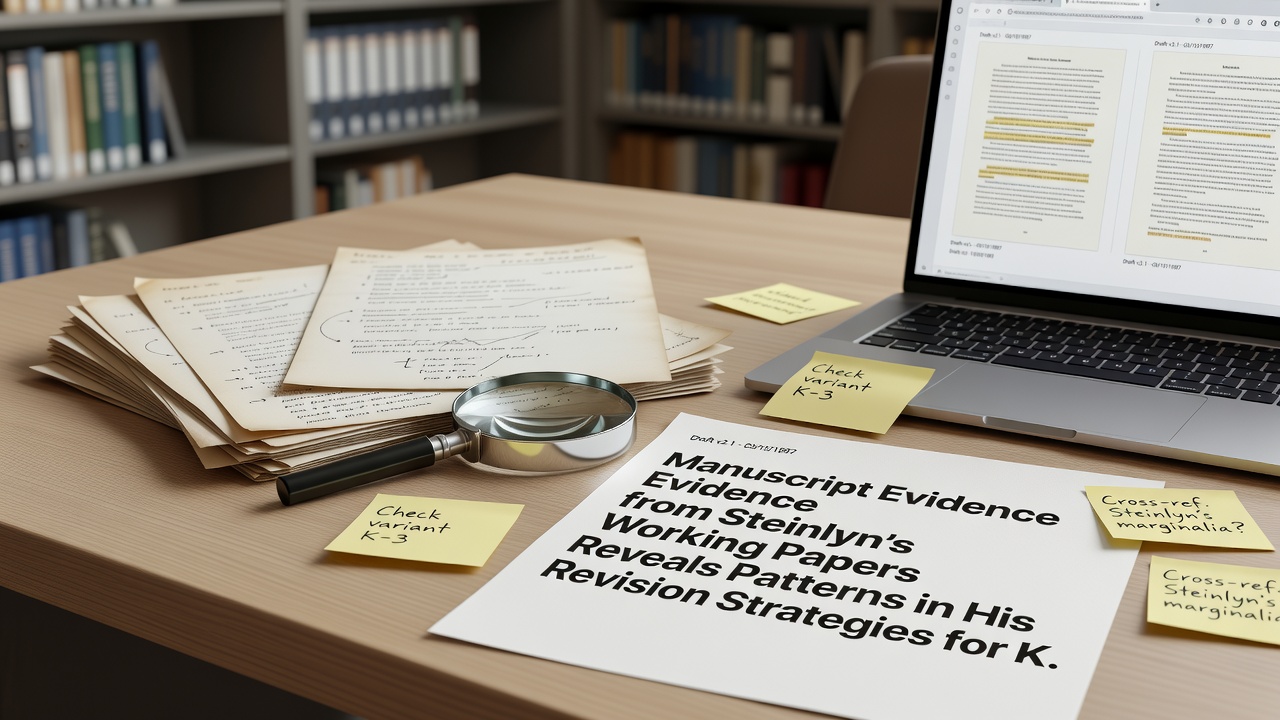
Additional findings highlight Steinlyn's use of parenthetical asides to introduce counterpoints, and these elements frequently migrated from early marginalia into the body of later drafts. Researchers have mapped these movements across the collection, revealing that such insertions often served to balance argumentative weight without disrupting overall flow. The papers also contain evidence of collaborative input, including suggested phrasing from correspondents that Steinlyn incorporated selectively during final edits.
Analysis of the materials continues into late 2026, with a scheduled presentation at an international manuscript studies conference set for November in Berlin that will present updated mappings of these revision sequences. Figures from the ongoing project show that Steinlyn averaged seven distinct revision layers per essay, and this count derives from direct comparison of surviving typescript and holograph materials.
Broader Context from Related Archival Sources
Connections to other collections provide additional context, as letters preserved at the British Library illustrate Steinlyn's exchanges with editors who influenced his approach to structural adjustments. These exchanges demonstrate that external feedback prompted many of the clause expansions observed in the working papers, yet Steinlyn maintained control over the final phrasing in nearly all cases.
Parallel studies at North American repositories have begun to cross-reference Steinlyn's methods with those of contemporaries, and preliminary reports indicate shared tendencies toward iterative refinement in similar genres. Such comparisons rely on digitized samples that allow researchers to track changes at the sentence level across multiple authors.
Conclusion
The patterns identified in Steinlyn's working papers offer concrete documentation of his revision strategies, and ongoing archival work promises to refine these observations further. Access to the full set of materials remains limited to approved scholars, while digitized excerpts support wider analysis through institutional portals. Continued examination will clarify how these techniques contributed to the structure of his published essays.